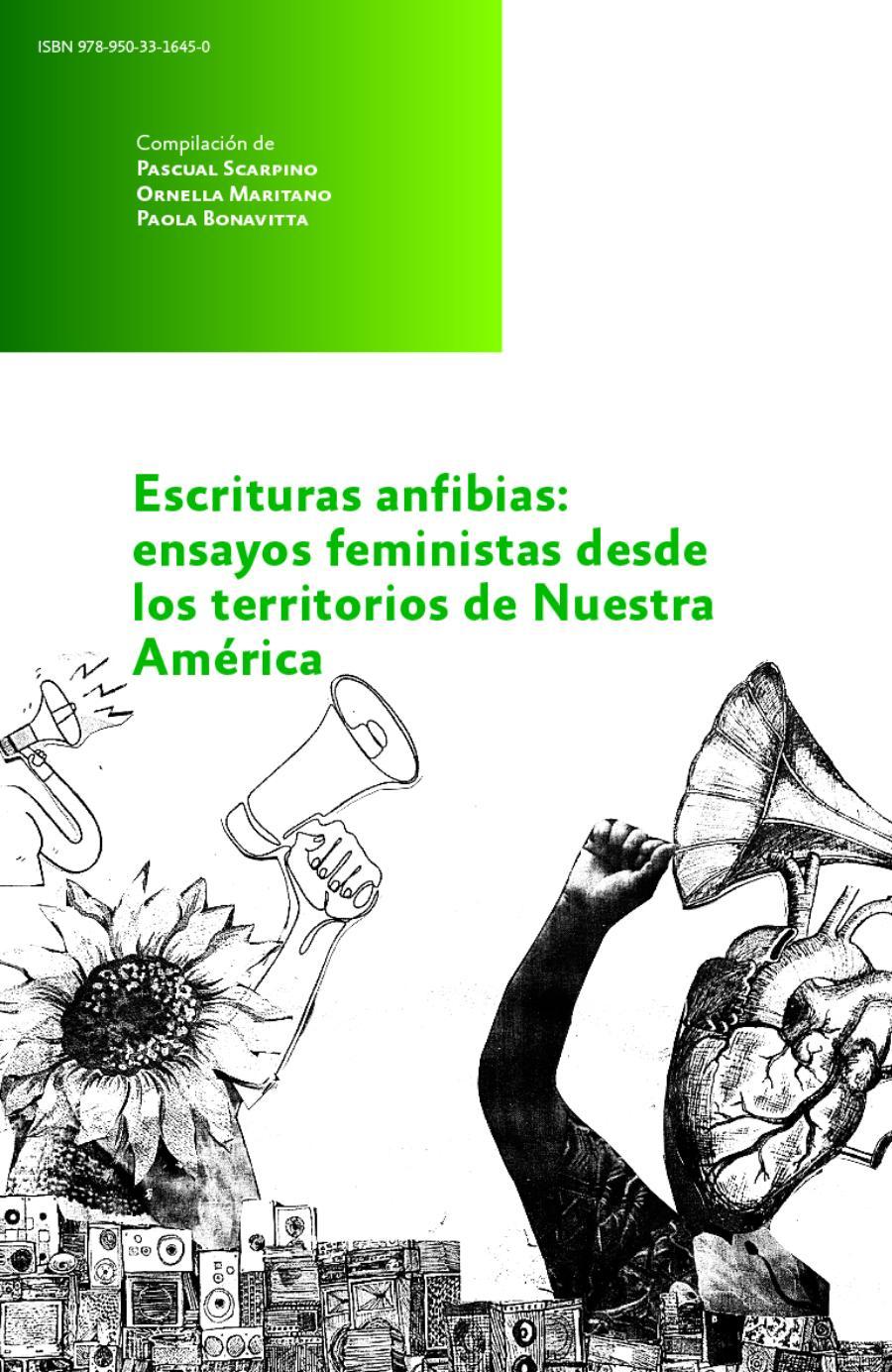
Amphibious Writings: Feminist Essays from the Territories of Our America
Keywords:
femiinism, decolonialismSynopsis
The research team “Feminist Epistemologies: Convergences of Body/Knowledge for the Decolonization of Knowledge, Power, and Gender,” led by Gabriela Bard Wigdor, co-based in the Area of Feminisms, Gender, and Sexualities (FemGeS) of the María Saleme de Burnichon Research Center (FFyH-UNC) and carried out by the working group “El Telar: community of Latin American feminist thought,” seeks to produce pluriversal and decolonial knowledge about local issues affecting feminized subjects in the Global South. Drawing on the contributions of thinkers and activists from Our America, with an emphasis on decolonial feminisms as an approach, practice, and process for the construction of a good life, the team has been developing biweekly spaces for reading and internal training, circulating readings from Our America and the Caribbean, as well as from key intellectuals of post- and decolonial thought. As part of these processes of reading, debate, and internal production, in April 2019, at the National University of Córdoba, they created a space for learning, debate, and epistemic/political construction with Adriana Guzmán, an Aymara feminist leader from the Bolivian organization “Feminismo Comunitario Antipatriarcal” (Anti-Patriarchal Community Feminism). Within the framework of this activity, the team took on the challenge of sharing their knowledge with the university and activist community of Córdoba and, to this end, coordinated with multiple institutions such as the Faculty
Chapters
-
Introduction to amphibious reading
-
Foreword
-
What are we talking about when we talk about feminist research?
-
Where hope dwells
-
Chapter 1: Bodies-Territories in Our America
-
Feminist movement: meanings, bodies, and the State
-
There is something about feminism that has become bourgeois.
-
Chapter 2: Citizenship, resistance, and feminist and dissident social movements
-
From the margins to the center: equal civil marriage in El Salvador
-
#EleNão Movement: The roses of resistance bloom from the asphalt
-
The illusion of equality: subordinate citizenship of sexual and gender dissidents in Chile
-
Armando la alharaca. Alternative, popular, and feminist communication against patriarchal/state violence in Colombia
-
Chapter 3: The university as territory
-
The university(ies) as territory(ies) of feminist disputes
-
Social sciences and gender in Paraguay and the voices of feminist university movements
-
Social movements and universities: alliances and strategies in the face of the pandemic and Brazilian neoconservatism
-
Chapter 4: Epistemologies of oppressed corporealities Chapter 5: Epistemologies of the body
-
Hierarchical bodies: The coloniality of race, gender, and class in the first person
-
Do we need ethics? Feminist, decolonial, and gender-nonconforming interruptions
-
The epistemological is political. From academic common sense to common sense based on feeling and thought
-
Chapter 5: Feminist narratives and imaginations around care
-
A pair of red shoes for fifty pesos. Feminist articulations anchored in the contradiction of life/capital experience
-
The intimacy of care. A narrative approach based on affective epistemology
Downloads
Published
Series
Categories
License

This work is licensed under a Creative Commons Attribution-NonCommercial-ShareAlike 4.0 International License.