The FILO members: Students, and alumni of the UNC’s School of Philosophy and Humanities who were disappeared and murdered in the 1970s
Keywords:
1976–1983 coup d'état, 1976–1983 military dictatorship, students who disappeared and/or were murdered, graduates who disappeared and/or were murdered, Faculty of Philosophy and Humanities 1976–1983, memory, truth, justice, human rightsSynopsis
Over the years, the School of Philosophy and Humanities has built a strong commitment to memory, truth, and justice, which has translated into various institutional initiatives, establishing it early on as a leading institution within the University in relation to these issues. Alongside the struggles for democratic institutionalization and subsequent efforts to advance the academic and political revitalization of the Faculty, multiple efforts were organized and supported to raise awareness of the issue of human rights violations during the last military dictatorship. Initiatives were developed both by the offices of Student Affairs and Outreach, as well as by the Student Center, student groups, schools, departments, centers, or chairs with their teams of faculty and researchers.
In line with these definitions, we recognize the need to further integrate Memory and Human Rights as a core component of
university citizenship education, in strict alignment with the public university’s commitment to building a democratic, just, and egalitarian society. Across various aspects of institutional work, this has been the organizing principle of numerous academic projects, as well as a commitment to education firmly dedicated to ensuring “never again” to state terrorism, impunity for crimes against humanity, torture, death, the disappearance of individuals and their children, ideological persecution, dismissals, and police control of academic life.
Commemorating the 35th anniversary of the military coup in Argentina was an institutional decision that, from the outset, enjoyed strong support among members of our Faculty’s community. Faculty, students, and alumni resolutely set out to
envision the most diverse expressions that would also allow for varied forms of participation and engagement in a commemoration free from any trace of formality or stereotype.
A commemoration that would instead embrace all those expressions, reflections, and emotions surrounding
an event that is necessarily linked to very deep individual, group, and institutional identity processes.
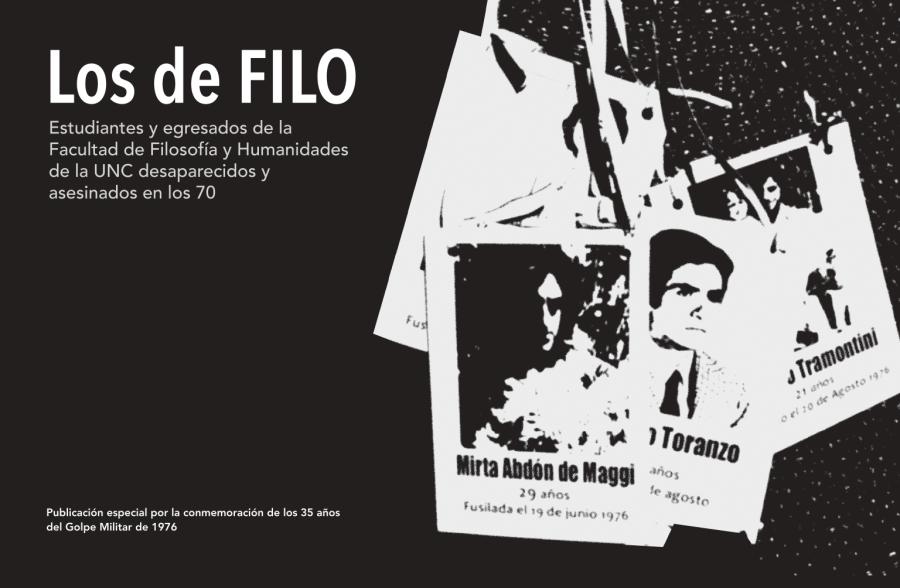
One of the most significant outcomes of these efforts is *Los de Filo*, a publication paying tribute to the students and alumni of the Faculty who were killed or disappeared. *Los de Filo* refers to a shared way of identifying ourselves, forged through
the vicissitudes of daily life. It is a plural term that points to the identities we seek to recover and acknowledge.
Recovering the identities of those who were part of our community at that time, through images and stories that fill gaps in our history.
Gaps that we are convinced must continue to be filled through collective construction, with the certainty that only in this way will we open a horizon that, in the present and looking toward the future, becomes more humane, without any kind of restriction.
In this regard, the work of the CDA research team provides data analyzed with methodological rigor and strict ethical safeguards, opening up new avenues of inquiry and calling for continued efforts to gather information, reconstruct details, and clarify references that shed greater light on the lives and activism of these comrades.
The articles published in “Alfilo” about the dictatorship are woven into the fabric of this text, deepening its meaning as they unfold stories that reflect an entire generation, and offer perspectives for analysis and reflection on the value of justice as a means of redress provided by the State.
Thirty-five years after the coup, at a time when this issue is stirring and mobilizing broad sectors of our society, with the significant emergence of the role of young people, this Faculty of Philosophy and Humanities renews its ethical, political, and academic commitment to deepening democratic life, advancing society in condemning State Terrorism and the political project that accompanied it, and expanding human rights in all their forms.
Chapters
-
Philosophy and the Humanities 35 Years After the Military Coup
-
he Construction of Memory and Institutional Challenges
-
Students and alumni of the UNC School of Philosophy and Humanities who were disappeared and/or murdered in the 1970s
-
Stories We Must Never Forget
-
List of students and alumni from the UNC School of Philosophy and Humanities who went missing and/or were murdered in the 1970s
-
Stories We Must Not Forget: A Collection of Articles - Alfilo Magazine
-
raciela Torres: A Rediscovered Identity
-
Those Who Were Executed
-
Documents from the Last Dictatorship: Evidence of the Military Intervention at the UNC
-
Menéndez's conviction: a triumph of the democratic will
Downloads
Published
Categories
License

This work is licensed under a Creative Commons Attribution-NonCommercial-ShareAlike 4.0 International License.