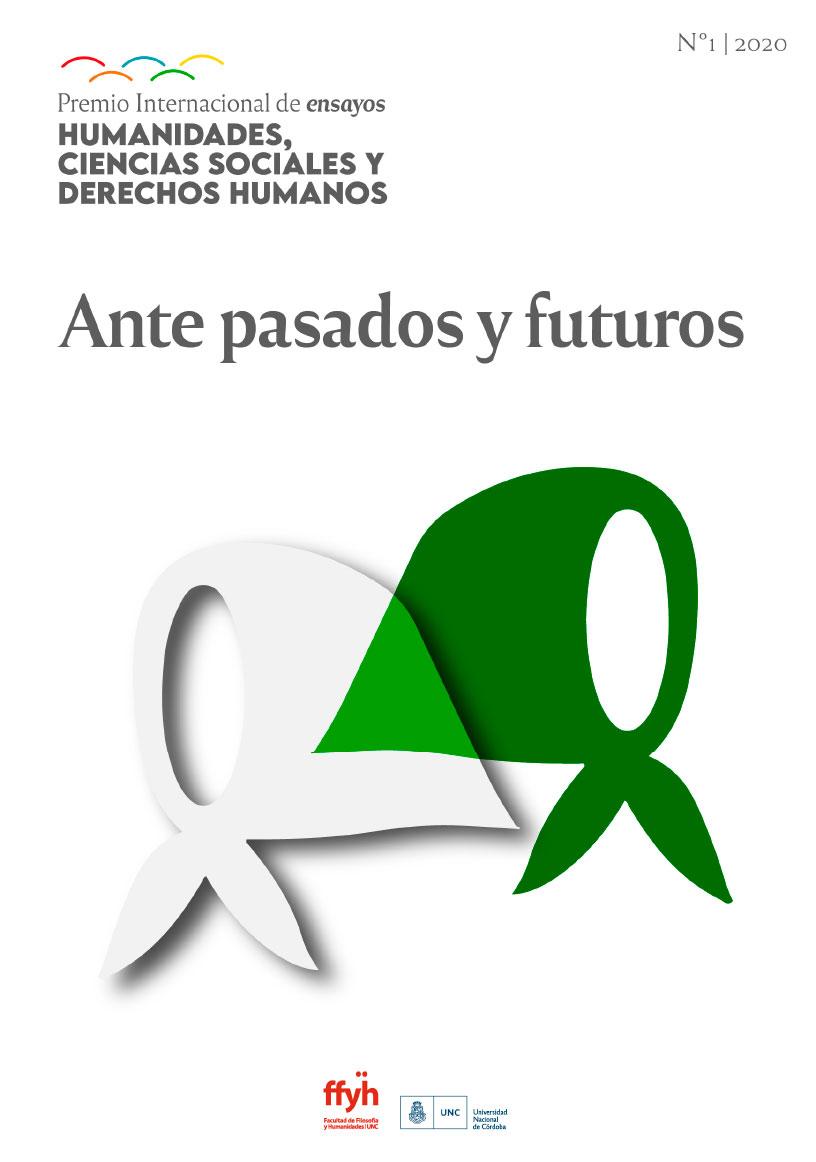
Facing the Past and the Future : International Essay Prize Humanities, Social Sciences, and Human Rights. Number 1. 2020
Keywords:
human rights, social sciences, humanities, military dictatorship – Latin America, crimes against humanity, Comahue – 2008–2019, migrant children – legal protection, migrant adolescents – legal protection, International Essay Prize in the Humanities, Social Sciences, and Human RightsSynopsis
In 2019, the Faculty of Philosophy and Humanities at the National University of Córdoba, at the initiative of its Human Rights Program, established the International Social Sciences and Human Rights Award in the Humanities through Resolution 58/2019 of February 25 issued by its Governing Board. As the Faculty of Philosophy and Humanities and the Human Rights Program, we chose this theme in recognition of the contributions that the Humanities and Social Sciences have made and can continue to make to the fields of research and advocacy, as well as to the organizations that champion these principles.
We also believe that placing human rights on the public agenda is central to education in the humanities and social sciences: the research and initiatives carried out in our faculty bear witness to the critical potential of these fields of knowledge to rethink the category of human rights, its tensions, and the need for its constant updating in order to contribute to a reflection on human rights practices and discourses.
Since the restoration of the rule of law, and with varying intensities and historical contexts, human rights have been at the center of political and theoretical disputes that have permeated the knowledge of academia and social movements; the formulation of state policies; and the shaping of public spaces at the local, national, and regional levels. In this sense, at the FFyH we consider it essential to keep alive, in the present we inhabit, the question of the legacy of these struggles, accompanying—through thought and creation—the political, imaginary, conceptual, and affective adventures and quests of the community. That is why we consider it important to promote this Award as a tool that upholds the insistence on human rights as the horizon and as the praxis of all democratic political culture.
This book is the result of a call for submissions in which the authors of the texts included here were awarded prizes. The texts were evaluated by a jury composed of Eugenia Almeida, Dora Barrancos, Ludmila da Silva Catela, Daniel Rafecas, and Eduardo Rinesi. We are publishing this volume out of conviction and desire. The conviction that knowledge and reflection on diverse experiences regarding human rights is a collective process, and that its publication catalyzes thought and action in this area. And the desire as an impetus to launch, starting with this volume, a series of contributions that confront us with the past and, in doing so, address the challenges that the future poses to us in the present.
Chapters
-
Oresentation
-
Foreword
-
Three Works on the Latin American Dictatorshipthe Man-Machine and the Mechanisms of Power
-
Justice and Concentration Camps. The Trials of the Perpetrators of Crimes Against Humanity in Comahue (2008–2019)
-
Standards for the Protection of the Rights of Migrant Children and Adolescents in the Inter-American Human Rights System
Downloads
Published
Categories
License

This work is licensed under a Creative Commons Attribution-NonCommercial-ShareAlike 4.0 International License.